





White Radish
Details & Complete Planting Guide
Ⅰ. Product Details
Variety Characteristics
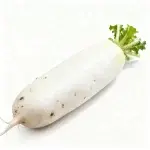
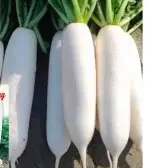
White Radish is a biennial root vegetable of the Brassicaceae family with a growth cycle of 50-70 days for spring sowing and 70-90 days for autumn sowing. The roots are cylindrical or oblong with white skin and flesh, 20-40cm in length and 5-10cm in diameter, weighing 0.5-2kg per root. It has strong adaptability, cold-resistant and suitable for cultivation in most regions of China.
Quality Advantages
- Roots are crisp and juicy with slightly sweet taste, rich in vitamin C, vitamin B complex, dietary fiber, potassium, calcium and digestive enzymes (amylase), with functions of promoting digestion and clearing heat.
- Multiple edible methods: Suitable for raw eating, stir-frying, soup cooking, pickling and drying, with high nutritional and economic value.
- Good storage performance: Mature roots can be stored in cellar or sand for 2-3 months, maintaining good quality and taste.
High-Yield Characteristics
Under proper cultivation management, the yield per mu can reach 4000-6000kg. The variety has strong disease resistance to downy mildew and black rot, suitable for dense planting with 8000-10000 plants per mu, and can be planted in rotation with other crops to improve soil fertility.
Anwendungsszenarien
- Fresh food market: As a common vegetable in daily diet, widely sold in supermarkets and farmers’ markets;
- Processing industry: Used for making pickled radish, dried radish, radish sauce and other processed products;
- Livestock feed: Leaves and old roots can be used as green feed for pigs, cattle and sheep, with high utilization rate;
- Traditional Chinese medicine: Roots and seeds have medicinal value, used for relieving cough and reducing phlegm.
Selection & Storage Suggestions
- Selection skills: Choose roots with straight shape, smooth skin, firm texture, no cracks, no insect damage and fresh leaves;
- Storage method:
- Short-term storage: Wrap with plastic wrap and store in refrigerator crisper for 7-10 days;
- Long-term storage: Store in sand in a cool and ventilated cellar, or cut into strips and dry for storage;
- Pickling: Can be made into pickled radish for long-term preservation.
Ⅱ. Planting Methods
Planting Preparation
1. Soil Selection
White Radish prefers loose, fertile, well-drained sandy loam or loam with pH value of 6.0-7.5. Avoid heavy clay soil and low-lying waterlogged land, and do not plant in soil with too much residual fertilizer or fresh manure to prevent root bifurcation. Deep plow the land 25-30cm before planting, apply base fertilizer: 2000-3000kg of decomposed organic fertilizer, 30kg of compound fertilizer per mu. Mix evenly and make flat ridges with width of 1-1.2m.
2. Seed Treatment
- Seed selection: Choose full, plump seeds with high germination rate, with seed consumption of 300-500g per mu;
- Seed soaking: Soak seeds in 20-25℃ warm water for 2-4 hours to promote germination, or sow dry seeds directly;
- Germination acceleration: Wrap soaked seeds with wet gauze and place at 20-25℃ for 12-24 hours, sow when seeds show white buds.
Sowing & Field Arrangement
1. Sowing Time
- Spring sowing: March to April, harvest in May to June, avoid late sowing to prevent bolting;
- Summer sowing: June to July, harvest in August to September, need shade in hot areas;
- Autumn sowing: August to September, harvest in October to November, the best planting season with high yield and good quality;
- Winter sowing: October to November in southern China, harvest in December to January next year.
2. Sowing Methods
- Drill sowing: Make shallow furrows 1-2cm deep on ridges with row spacing of 25-30cm, sow seeds evenly in the furrows, cover with 1cm fine soil, water thoroughly;
- Hole sowing: Dig holes with row spacing of 25-30cm and plant spacing of 20-25cm, sow 3-4 seeds per hole, cover with soil and water;
- Broadcast sowing: Suitable for small-area planting, mix seeds with fine soil and broadcast evenly, then rake lightly and water.
3. Thinning & Final Singling
- First thinning: When seedlings have 1-2 true leaves, thin out weak seedlings, keep plant spacing of 3-5cm;
- Second thinning: When seedlings have 3-4 true leaves, keep plant spacing of 10-15cm;
- Final singling: When seedlings have 5-6 true leaves, fix plant spacing at 20-25cm to ensure sufficient growth space for roots.
Field Management
1. Wasserwirtschaft
- Seedling stage: Keep soil moist to promote emergence, water frequently with small amount;
- Leaf growth period: Control watering properly to promote root down growth, water in time when soil is dry;
- Root expansion period: Ensure adequate water supply, water once every 5-7 days, keep soil moisture stable to prevent root cracking;
- Before harvest: Reduce watering 5-7 days before harvest to improve root quality and storage resistance.
2. Fertilizer Management
- Seedling fertilizer: Apply 5-8kg of urea per mu 10-15 days after emergence to promote seedling growth;
- Leaf fertilizer: Apply 10-15kg of compound fertilizer per mu at vigorous leaf growth stage;
- Root fertilizer: Apply 20-25kg of compound fertilizer + 10kg of potassium sulfate per mu at initial root expansion stage, focus on phosphorus and potassium fertilizer to promote root expansion;
- Avoid excessive nitrogen fertilizer to prevent excessive leaf growth and poor root development.
3. Soil Loosening & Weeding
- Loosen soil in time after rain or watering to keep soil loose and breathable, which is conducive to root growth;
- Remove weeds in time during seedling stage to avoid competition for nutrients, shallow tillage to prevent damaging roots;
- When roots begin to expand, soil can be hilled around roots to prevent roots from protruding and greening.
4. Disease & Pest Control
- Downy mildew and black rot: Use 75% chlorothalonil wettable powder 600x solution or 50% carbendazim wettable powder 800x solution for spray control;
- Clubroot: Use lime to adjust soil pH to 7.0-7.5, or use 50% fenaminosulf wettable powder 500x solution for root irrigation;
- Aphids and flea beetles: Control with 10% imidacloprid wettable powder 1500x solution or yellow sticky traps;
- Cabbage caterpillars and diamondback moth: Use Bt emulsion 500x solution or 2.5% deltamethrin emulsifiable concentrate 2000x solution for spray control.
Harvesting
- Harvest time:
- Spring-sown radishes: Harvest when roots are 0.5-1kg in weight (50-70 days after sowing), harvest in time to prevent bolting;
- Autumn-sown radishes: Harvest when roots are fully expanded and leaves turn yellow (70-90 days after sowing);
- Harvest before severe frost in northern China to prevent freezing damage.
- Harvesting method: Pull out radishes by hand or dig them out with a shovel, cut off leaves (retain 2-3cm petioles), clean soil on roots;
- Post-harvest treatment:
- Fresh sale: Sort by size, remove damaged roots, wash and package;
- Storage: Store in sand in a cellar with temperature of 0-5℃ and relative humidity of 80-90%;
- Processing: Cut into strips for drying or make pickled radish.




Bewertungen
Es sind noch keine Bewertungen vorhanden.