


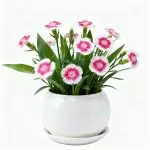
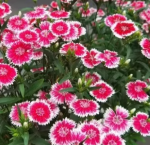
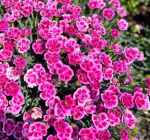



Chinese Pink (Dianthus chinensis)
Vibrant Blooms & Hardy Charm | Complete Details & Cultivation Guide
I. Visión general de la planta
| Artículo | Detalles |
|---|---|
| Nombre científico | Dianthus chinensis L. |
| Familia y género | Caryophyllaceae (Pink Family), Dianthus |
| Nombres comunes | Chinese Pink, Rainbow Pink, China Pink, Luoyang Flower |
| Origen | China, South Korea, Japan; widely cultivated in temperate regions globally |
| Ciclo de crecimiento | Perennial herb, often grown as annual/biennial |
| Periodo de floración | May-September; individual flowers bloom for 5-7 days, whole plant flowering period lasts 3-4 months |
| Escenarios adecuados | Balcony pots, garden clumps, flower beds, borders, cut flowers, urban greening |
As one of China’s traditional famous flowers, Chinese Pink is cherished for its compact low-growing habit (20-40 cm tall), slender tough stems, and elegant linear leaves. Its distinctive funnel-shaped or bell-shaped flowers feature delicately serrated petals in a rich palette of red, pink, white, purple, and bicolor shades—some varieties even emit a faint fragrance. Exceptionally adaptable, it tolerates cold, drought, and poor soil, making it a versatile choice for balconies, gardens, and public landscapes. With abundant blooms and a long flowering season, it balances ornamental and practical value perfectly, remaining a popular gardening favorite.
II. Características morfológicas
Chinese Pink forms dense clumps with a compact, graceful shape and high ornamental value:
- Vástago: Erect or ascending, 20-40 cm tall, cylindrical with distinct nodes, smooth or slightly pubescent, green or pale purple. Strong branching ability forms a compact plant shape.
- Hojas: Opposite, linear-lanceolate or strap-shaped, 3-5 cm long and 0.3-0.5 cm wide, with smooth margins and glossy emerald green surfaces. Parallel veins, clasping the stem at the base, with strong drought resistance.
- Flores: Solitary or clustered at stem apices, 2-5 cm in diameter. Calyx is tubular (1.5-2.5 cm long) with 5 lobes; 5 fan-shaped or elliptical petals with irregular serrated or fringed edges. Flower colors include bright red, pink, white, purple, pale purple, and red-white bicolor—some varieties have spotted or striped petals. 10 stamens and 1 pistil with 2-lobed stigma.
- Fruta: Capsule, oblong or cylindrical, dehiscing at the top when mature, containing numerous small seeds. Seeds are black or dark brown, flattened orbicular with fine textures, 1000-seed weight 0.5-0.8 grams, germination rate lasts 3-4 years.
III. Hábitos de crecimiento
Chinese Pink is a typical sun-loving, cold-tolerant, drought-tolerant, and poor-soil-tolerant plant, preferring cool dry climates and avoiding high temperature, high humidity, and waterlogging:
- Temperatura: Optimal growth temperature 15-25℃; seed germination requires 15-20℃ (best at 18-20℃). Extremely cold-hardy—most varieties tolerate -10℃, some hardy types withstand -15℃. Poor heat tolerance: growth slows above 30℃ in summer; provide shade to prevent leaf yellowing and reduced flowering.
- Luz: Absolutely sun-loving, requiring 6-8 hours of direct sunlight daily. Sufficient light promotes more branches, abundant blooms, and vibrant colors; insufficient light causes leggy growth, weak stems, sparse flowering, and dull colors—even no flowering.
- Suelo: Undemanding, preferring loose, well-drained, humus-rich slightly acidic to neutral soil (pH 6.0-7.5), ideally sandy loam or humus loam. Tolerates poor soil and grows in ordinary garden soil but intolerant of heavy, waterlogged soil. Compacted or waterlogged soil easily leads to root rot and death.
- Agua: Drought-tolerant, intolerant of waterlogging. Follow the principle of “water only when dry, water thoroughly when watering”—slightly dry soil is optimal. Keep soil slightly moist during seedling stage to promote root development; strictly control water for mature plants.适当 increase watering frequency in hot summer but avoid waterlogging; reduce water in winter to keep soil slightly dry for frost protection.
- Características especiales: Fast growth rate—2-3 months from sowing to flowering; strong tillering ability forms clumping plants; long flowering period with frequent blooms—pruning promotes secondary flowering; resistant to harmful gases (sulfur dioxide, chlorine), suitable for urban greening.
IV. Valores fundamentales
1. Ornamental Value: Vibrant Colors & Long Flowering Season
With a compact low-growing habit, rich vibrant colors, and unique serrated petals, Chinese Pink is highly ornamental. It produces abundant blooms over a long period (spring to autumn), making it a key flowering plant in landscapes. Whether as balcony potted plants, garden clumps, flower bed plantings, or border edgings, it creates a colorful, lively scene with exceptional ornamental value.
2. Practical & Economic Value: Versatile Uses
Chinese Pink is an excellent cut flower with slender stems and long vase life (7-10 days), suitable for bouquets, flower baskets, and floral arrangements. Some fragrant varieties are used for essential oil extraction in aromatherapy and perfumes. Its compact size makes it an ideal potted flower with high market demand and economic value. Additionally, the entire plant is medicinal, with effects of clearing heat, promoting diuresis, and activating blood circulation.
3. Ecological Value: Air Purification & Greening
Chinese Pink has strong resistance and adsorption capacity for harmful gases (sulfur dioxide, chlorine), improving air quality when planted in gardens, parks, or urban green belts. Its well-developed root system and strong tillering ability provide good coverage, making it suitable as a groundcover to prevent soil erosion. With abundant nectar-rich blooms, it serves as an important nectar source for bees, butterflies, and other beneficial insects, promoting ecological balance.
V. Guía de cultivo científico
1. Planting Time Selection: Spring & Autumn Optimal
Chinese Pink prefers cool dry environments; plant in spring or autumn for optimal growth and flowering, avoiding extreme heat and cold:
- Plantación de primavera: Southern regions (Yangtze River Basin and south) can sow or transplant in February-March; northern regions (Yellow River Basin and north) in March-April. Stable temperature rise and sufficient light facilitate seedling acclimation and vigorous growth—blooms in summer.
- Plantación de otoño: Southern regions can sow or transplant in September-October; northern regions complete by August-September to allow plants to form robust growth before winter, improving cold resistance—abundant blooms in next spring.
- Cultivo de plántulas: For seed propagation, start seedlings indoors in February-March (temperature 18-20℃) or direct sow outdoors in April-May. Seedlings emerge in 10-15 days; transplant when 4-6 true leaves form.
2. Soil Preparation: Loose & Well-Drained
Chinese Pink adapts to various soils, but well-prepared soil promotes vigorous growth and abundant flowering:
- Ratio de suelo: Recommended formula: 4 parts garden soil + 3 parts leaf mold + 2 parts river sand + 1 part perlite. Mix well and expose to sun for 3-5 days to disinfect, killing insect eggs and pathogens.
- Mejora del suelo: For heavy clay soil, increase river sand/perlite ratio to improve drainage; for poor soil, mix in decomposed organic fertilizer or compound fertilizer to enhance fertility.
- Aplicación de abono base: Mezcle abono orgánico descompuesto (10-15 kg por mu) o abono compuesto en la tierra antes de plantar, asegurándose de que se mezcla completamente para evitar que se quemen las raíces. Para las plantas en maceta, coloque ceramita o grava en el fondo para mejorar el drenaje.
3. Planting Methods: Sowing, Cuttings, Division
Chinese Pink can be propagated by sowing, cuttings, or division. Sowing is simple for home cultivation; cuttings and division preserve parent plant traits:
- Siembra Propagación: Soak seeds in 30℃ warm water for 4-6 hours, dry and evenly spread on seedling medium, cover with 0.3-0.5 cm thin soil. Keep medium moist at 18-20℃; seedlings emerge in 10-15 days. Thin seedlings at 2-3 true leaves, transplant at 4-6 true leaves (1-2 plants per pot/hole, spacing 15-20 cm).
- Propagación del corte: Conduct in April-May (spring) or August-September (autumn). Select healthy current-year shoots, cut into 8-10 cm cuttings, remove lower leaves, retain 2-3 top leaflets. Soak lower part in rooting solution for 5-10 minutes, insert into river sand/perlite medium (1/3-1/2 depth). Keep moist at 20-25℃; roots form in 15-20 days.
- Propagación de divisiones: Optimal in March-April (spring) or September-October (autumn). Dig up healthy mother plants, gently separate clumps, each retaining 3-5 buds and complete roots. Trim rotten roots and overlong branches, transplant and water thoroughly—blooms in the same year.
- Planta en maceta Nota: Choose 20-25 cm diameter pots with drainage holes, plant 1-2 plants per pot to avoid poor ventilation.
4. Gestión de la fase de plántula: Aclimatación y fomento del crecimiento
The seedling stage (1-2 months after transplanting) is crucial for adapting to the environment and forming a robust plant shape:
- Gestión de la aclimatación: Coloque las plántulas trasplantadas en un lugar fresco y bien ventilado durante 3-5 días para que se aclimaten, evitando la luz solar directa. Aumentar gradualmente la luz hasta pleno sol después de que las hojas recuperen la turgencia.
- Control del agua: Keep soil slightly moist during seedling stage, strictly prohibit waterlogging. Water in the morning with a spray bottle or along pot edges, avoiding wetting leaves and flowers.
- Gestión de fertilizantes: No fertilizar durante la fase de plántula. Después de la aclimatación (1 mes después del trasplante), aplicar fertilizante compuesto NPK diluido (concentración 1000x) para promover el crecimiento del follaje-evitar el exceso de nitrógeno que causa el crecimiento leggy.
- Desherbar y aflojar el suelo: Elimine regularmente las malas hierbas para evitar la competencia de nutrientes; afloje el suelo 1-2 veces al mes para favorecer la respiración de las raíces y evitar la compactación.
5. Gestión del periodo de crecimiento: Agua, abono y poda
From acclimation to budding (2-3 months), Chinese Pink grows rapidly—strengthen management to promote branching and flowering:
| Tema de gestión | Métodos específicos |
|---|---|
| Riego | Strictly control water for mature plants: water only when soil surface is dry and white, ensuring water flows out from pot bottom. Loosen soil after watering to avoid waterlogging.适当 increase frequency in hot summer but control volume; reduce water in winter to keep soil slightly dry for frost protection. |
| Fertilización | Topdress 2-3 times during growth: apply NPK compound fertilizer (8-10 kg per mu) before budding to promote flower bud differentiation; spray 0.2% potassium dihydrogen phosphate during flowering to extend bloom time and enhance color; apply decomposed organic fertilizer in autumn to improve cold resistance. Avoid excessive nitrogen fertilizer. |
| Poda | Cut off withered winter branches and diseased/weak branches after spring sprouting; pinch tops when plants reach 15-20 cm to promote lateral branching and increase flower count; promptly cut off spent flowers and lower branches after flowering to reduce nutrient consumption and encourage secondary blooming. |
| Control de la temperatura | Provide shade or move to cool well-ventilated area when summer temperature exceeds 30℃ to avoid leaf scorching and flowering inhibition; insulate potted plants with thermal bags or move to sunny indoor locations when winter temperature is below -10℃; mound 5-8 cm soil around roots of field-grown plants for frost protection. |
6. Gestión de la floración y posfloración
- Gestión de la luz: Asegúrese de que recibe de 6 a 8 horas diarias de luz solar directa durante el período de floración. Suficiente luz asegura colores vibrantes y abundantes floraciones-proporcionar luz suplementaria si es insuficiente.
- Control del agua: Mantenga el suelo ligeramente húmedo durante la floración para evitar que las flores se marchiten por la sequía y que las raíces se pudran por encharcamiento. Regar por la mañana o por la noche.
- Polinización auxiliar: Chinese Pink is cross-pollinating; outdoor plants rely on bees and other insects for natural pollination. For closed home environments, gently shake flower clusters to assist pollination and improve seed setting rate.
- Post-Flowering Recovery: Promptly cut off spent flowers and 1-2 pairs of lower leaves after blooming to reduce nutrient consumption; apply dilute phosphorus-potassium fertilizer to promote plant recovery and reserve nutrients for secondary flowering; remove diseased and withered leaves to maintain ventilation and light penetration.
7. Control de plagas y enfermedades
Chinese Pink is adaptable with few pests and diseases. Common issues and control methods:
(1) Enfermedades: Pudrición de la raíz, Mancha foliar, Mildiú polvoroso
- Prevención: Regar razonablemente para evitar el encharcamiento; mantener la ventilación y la penetración de la luz; evitar el hacinamiento.
- Controlar: Pulverizar 800x carbendazim o 1000x tiofanato-metil en la fase inicial, una vez cada 7-10 días durante 2-3 veces. Para la podredumbre de las raíces, desenterrar las plantas, cortar las raíces podridas, desinfectar y replantar.
(2) Pests: Aphids, Spider Mites, Cabbage Worms
- Pulgones: Pulverizar 1500x de solución de imidacloprid.
- Ácaros araña: Pulverizar 1000x de solución de abamectina, centrándose en el envés de las hojas.
- Cabbage Worms: Recoger a mano o pulverizar 1000x de solución de lambda-cihalotrina.
- Control ecológico: Interplantar con plantas repelentes de plagas como la menta y el ajo.
8. Cosecha y utilización
- Tiempo de cosecha: Ornamental flowers—harvest when fully open and most vibrant; cut flowers—harvest at semi-open stage for longer vase life; seeds—harvest when capsules mature and dehisce, collect promptly to avoid scattering.
- Método de cosecha: Cut cut flowers at stem base with scissors on sunny mornings after dew dries; pick mature capsules for seeds, dry and rub to collect seeds.
- Procesamiento y utilización: Fresh cut flowers have 7-10 day vase life for floral arrangements; dry seeds for next year’s sowing; harvest entire plant during flowering, wash and dry for medicinal use.
- Conservación de semillas: Select healthy plants with beautiful flowers and vibrant colors for seed saving. Collect and clean seeds, remove impurities and shrunken grains, store in sealed containers in a dry, cool, well-ventilated place.



Kit de plantación de aliento de bebé
El precio original era: $15.20.$9.80El precio actual es: $9.80.


Reseñas
Aún no hay opiniones.