Money String Succulent - Product Details & Care Guide
Money String Succulent (Crassula perforata)
Weave Wealth + Cute Appearance, An Easy-Care Fortune-Bringing Green Plant For Beginners
Detalles del producto
Características principales
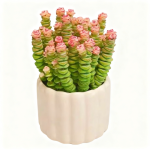
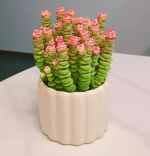
A succulent plant of the Crassulaceae family, named for its plump elliptical leaves arranged closely opposite each other, resembling strings of stacked copper coins – a recognized "fortune-attracting" auspicious green plant.
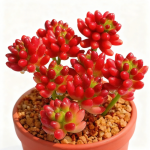
Leaf color ranges from emerald green to deep green year-round. Under sufficient light, leaf edges turn reddish, with plump and thick leaves and a compact, neat plant shape, exuding a cute and lovely texture.
Symbolizes "attracting wealth and treasure, prosperous fortune, and steady progress" – a "gateway plant" for gardening beginners with strong adaptability, drought tolerance, and low maintenance requirements.
Leaves can absorb tiny dust particles in the air and release oxygen, suitable for long-term indoor placement, combining auspicious meaning, ornamental value, and practical functions.
Requires no frequent care and grows steadily, making it an excellent choice for decorating spaces and conveying good wishes to relatives and friends.
Escenarios de aplicación
Maceta de escritorio: Small money string placed on desks or office tables, symbolizing "rolling wealth" – compact shape saves space and relieves eye strain.
Pantalla de salón: Medium to large clumping money string with primitive pots placed in the wealth corner or entrance cabinet of the living room, serving as a "fortune-enhancing ornament" to improve space style.
Balcón Paisajismo: Combined with other succulents in arrangements or placed alone on balcony shelves – leaf edges turn red under sufficient light, creating a strong atmosphere.
Regalar: Packaged as gifts for friends opening businesses, new professionals, and elders, symbolizing "prosperous business and good fortune" – both heartfelt and attractive.
Decoración de estudios: Placed on study bookshelves or windowsills, the emerald green leaves and auspicious meaning add good luck and vitality to study and work.
Especificaciones
Altura de la planta: 8cm / 15cm / 20cm / 30cm (including leaf height, stems semi-lignified)
Tamaño del toldo: 6cm / 12cm / 18cm / 25cm (single plant or 3-6 heads clumping optional)
Material de la maceta: Maceta de terracota transpirable / Maceta de cerámica rugosa / Maceta de plástico simple (opcional, con orificios de drenaje)
Estado de crecimiento: Plump non-wilted leaves, closely arranged, pest-free, with original soil clod
Rasgos varietales: Strong water storage capacity in leaves, growing season in spring and autumn, semi-dormant in summer, strong cold tolerance (can withstand 5℃ low temperature)
Guía de cuidados y cultivo
1Pot & Soil: Ventilation & Drainage Are Key to Attracting Wealth
Dé prioridad a las macetas de terracota o cerámica rugosa con agujeros de drenaje, de 1-2 cm de diámetro más pequeños que la copa; evite las macetas demasiado grandes para evitar la pudrición de las raíces por encharcamiento.
Money string has a compact shape; small pots are more conducive to shape control and avoiding leggy growth.
Soil formula: Granular soil (akadama + maifan stone + lava rock) + nutrient soil = 6:4, or use succulent-specific soil mixed with a small amount of slow-release fertilizer (buried at the bottom, away from roots). Ensure soil is loose, breathable, and non-compacted for drainage and root respiration.
2Light Requirements: Sufficient Light for "Red-Edged Money String"
Need sufficient light in spring, autumn, and winter – 3-5 hours of direct sunlight daily (south-facing balcony/windowsill is best). The more sufficient the light, the closer the leaf arrangement, the more obvious the red leaf edges, and the neater the plant shape.
Summer shade: Provide 40% shade when temperature exceeds 32℃ (use sunshade net or move to scattered light area) to avoid leaf scorching, yellowing, and rotting.
Insufficient light causes sparse, elongated leaves, light color, and leggy stems – supplement light in time with succulent grow lights (3-4 hours daily) to restore compact shape.
3Principios de riego: Mejor seco que mojado, evitar el encharcamiento
Seguir estrictamente "Regar sólo cuando esté seco, regar a fondo al regar" – water only when soil is completely dry (test with a toothpick: no moisture when pulled out) or leaves are slightly wilted and soft. Avoid frequent watering to prevent root rot.
Spring & Autumn: Water every 10-15 days during the growing season, pour slowly along the pot edge for full soil absorption. Avoid splashing water into leaf gaps (prevent bacteria growth and leaf rot).
Riego en verano: Reduzca el riego durante el periodo de semi-dormancia - riegue con "agua de supervivencia" cada 20-30 días (una pequeña cantidad a lo largo del borde de la maceta para mantener la tierra ligeramente húmeda) para evitar la podredumbre negra provocada por las altas temperaturas y la humedad.
Riego en invierno: Controle el agua cuando la temperatura sea inferior a 5℃ - riegue cada 30-40 días o deje de regar por completo, mantenga el suelo seco para evitar la congelación de las raíces.
4Temperature Adaptation: Optimal 15-28℃ for Steady Growth
Optimal growth temperature: 15-28℃ – leaves are plump, growth is rapid, plant shape is compact, and leaf edges are prone to reddening in this range.
Winter protection: Move indoors to a warm place when temperature is below 5℃, away from cold drafts, maintain temperature ≥5℃ to avoid leaf freezing and stem rot.
Enfriamiento en verano: Trasladar a una zona sombreada y bien ventilada cuando la temperatura supere los 35℃, mejorar la circulación del aire (utilizar un pequeño ventilador si es necesario) para evitar la pudrición de las hojas por congestión.
5Fertilization: Thin Fertilizer Applied Frequently for "Wealth Upgrade"
Abone sólo en primavera y otoño, y deje de hacerlo en verano e invierno para evitar que se queme el abono.
Selección del abono: Utilizar abono de liberación lenta específico para suculentas (enterrado una vez durante la temporada de crecimiento, válido durante 3-6 meses) o abono líquido diluido para suculentas (1/4 de la concentración recomendada). Evite los fertilizantes con alto contenido en nitrógeno (propensos al crecimiento espigado).
Fertilization frequency: Apply liquid fertilizer once a month along the pot edge, avoiding direct contact with roots and leaves. Supplement slow-release fertilizer every 3 months, adjust dosage according to plant size (about 1 gram).
Prune best in spring and autumn growing seasons – promptly trim dry leaves, weak branches, and leggy branches to avoid nutrient consumption.
Shaping method: For clumping plant shape, cut the top branches in spring to promote side shoot growth and make the "money string" denser. Ensure sufficient light + water control daily to prevent stem leggy and "loose strings".
Dry leaf cleaning: Regularly remove dry leaves in leaf gaps and pots for beauty and ventilation, preventing pest and disease growth.
7Repotting & Propagation: "Wealth Inheritance"
Trasplantar cada 1-2 años, mejor en primavera (marzo-abril). Retire con cuidado la planta de la maceta, sacuda un poco la tierra vieja, elimine las raíces podridas y secas, y deje secar al aire durante 1-2 días antes de trasplantar.
Propagation method: Money string is extremely easy to propagate, using cuttings or division in spring. Cuttings: Cut healthy branches (with 3-4 pairs of leaves), air-dry the cut for 2-3 days, insert into moist granular soil, and roots will form in 2-3 weeks. Division: Naturally separate clumping plants from the roots, directly repot with a small amount of roots – survival rate is extremely high.
8Pest & Disease Control: Protect "Wealth" from Loss
Enfermedades comunes: Black rot and leaf spot (mostly caused by waterlogging and poor ventilation). At the initial stage, remove the plant from the pot, cut off rotten parts, disinfect the cut with carbendazim solution, repot with new soil, and strengthen ventilation and water control later.
Plagas comunes: Cochinillas y arañas rojas. Para un número reducido de plagas, limpie las hojas y los tallos con un algodón empapado en alcohol. Para infestaciones graves, pulverice insecticida específico para suculentas una vez a la semana durante 2-3 semanas consecutivas, asegurándose de cubrir totalmente la superficie y el envés de las hojas.
Reseñas
Aún no hay opiniones.
Sé el primero en opinar “Lucky Money Plant String of Coins (20 stems, pot not included)” Cancelar la respuesta
MAECENAS IACULIS
Vestibulum curae torquent diam commodo parturient penatibus nunc dui adipiscing convallis bulum parturient suspendisse parturient a.Parturient in parturient scelerisque nibh lectus quam a natoque adipiscing a vestibulum hendrerit et pharetra fames nunc natoque dui.
ADIPISCING CONVALLIS BULUM
Vestibulum penatibus nunc dui adipiscing convallis bulum parturient suspendisse.
Abitur parturient praesent lectus quam a natoque adipiscing a vestibulum hendre.
Scelerisque adipiscing bibendum sem vestibulum et in a a purus lectus faucibus lobortis tincidunt purus lectus nisl class eros.Condimentum a et ullamcorper dictumst mus et tristique elementum nam inceptos hac parturient scelerisque vestibulum amet elit ut volutpat.




 English
  German
 Spanish
 Japanese




Reseñas
Aún no hay opiniones.