





Muma Mountain Yam Bean
Details & Complete Planting Guide
Ⅰ. Product Details
Variety Characteristics
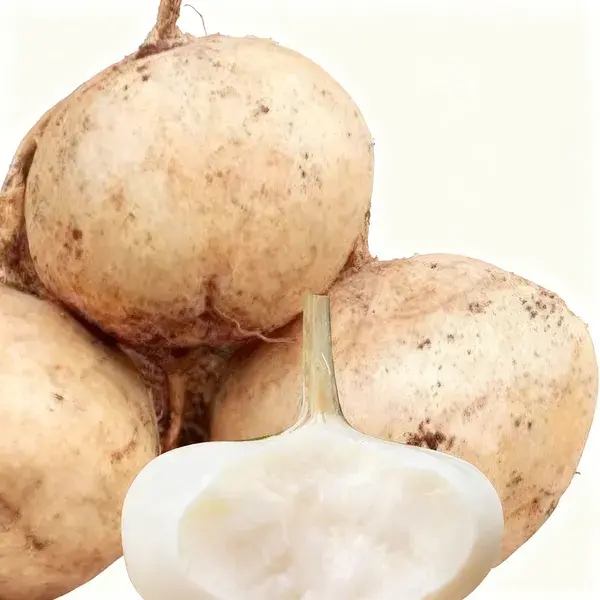
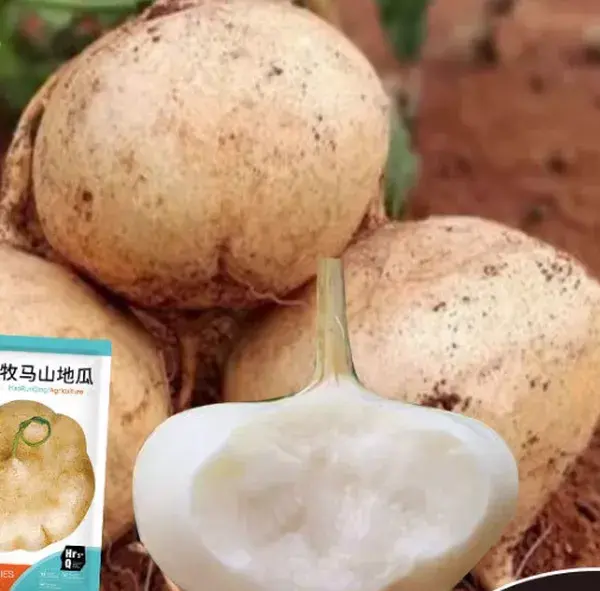
Muma Mountain Yam Bean (also known as Jicama or Pachyrhizus erosus) is a perennial vine tuber crop of the legume family, with an annual cultivation cycle of 180-210 days. The plant has climbing vines with trifoliate leaves, and the tubers are spherical or oblate with light yellow skin and white crisp flesh, weighing 0.5-2kg per tuber. It is heat-resistant and drought-tolerant, suitable for cultivation in warm and sunny regions.
Quality Advantages
- Flesh is crisp and juicy with a sweet taste, containing 8-10% sugar and rich in vitamin C, dietary fiber, potassium, calcium and iron. It is low in calories and high in water content, suitable for raw eating, stir-frying and salad.
- Excellent storage performance: Mature tubers can be stored in a cool and dry place for 2-3 months, and at 5-10℃ for 4-6 months, with good preservation of crispness and taste.
- Multiple uses: Tubers can be eaten fresh or processed into dried chips, pickles and starch; vines and leaves can be used as livestock feed, with high comprehensive utilization value.
High-Yield Characteristics
Under proper cultivation management, the yield per mu can reach 3000-5000kg. The variety has strong adaptability to soil, can grow in sandy loam, loam and light clay soil, with developed root system and strong stress resistance, suitable for planting in most regions south of the Yangtze River in China.
Application Scenarios
- Fresh food market: Sold as a seasonal fruit and vegetable, popular in supermarkets and farmers’ markets for raw eating and cooking;
- Processing industry: Used for making dehydrated yam bean chips, canned yam beans, pickled products and starch extraction;
- Health food: As a low-calorie, high-fiber health food, it is widely used in weight loss meals and healthy diets.
Selection & Storage Suggestions
- Selection skills: Choose tubers with smooth skin, no damage, no insect eyes, firm texture and uniform size, avoid tubers with soft spots or mold;
- Storage method: Store in a cool, dry and ventilated place with temperature of 5-15℃, spread in a single layer or store in a sand pit, avoid direct sunlight and moisture.
Ⅱ. Planting Methods
Planting Preparation
1. Soil Selection
Muma Mountain Yam Bean prefers loose, fertile, well-drained sandy loam or loam with pH value of 6.0-7.5. Avoid low-lying waterlogged land and heavy clay soil. Deep plow the land 30-40cm before planting, remove weeds and stones, apply base fertilizer: 2000-3000kg of decomposed organic fertilizer, 40kg of compound fertilizer and 20kg of potassium sulfate per mu. Mix evenly and make ridges with width of 80-100cm and height of 20-30cm.
2. Seed Tuber Preparation
- Seed selection: Choose healthy tubers with no disease, no damage and weight of 100-200g as seed tubers;
- Germination: Cut seed tubers into pieces of 50-100g with 1-2 buds per piece, dry the cut surface for 1-2 days, then place in a warm and humid place (25-30℃) for germination, and plant when buds are 1-2cm long.
Planting & Field Arrangement
1. Planting Time
- Spring planting: Plant when soil temperature stabilizes above 15℃ (late March to early April in southern China, early May in northern China);
- Avoid planting in low temperature and rainy season to prevent seed tuber rot.
2. Planting Methods
- Dig planting holes on ridges with row spacing of 80-100cm and plant spacing of 50-60cm, with 1200-1500 plants per mu;
- Place seed tubers in holes with buds facing up, cover with 5-10cm fine soil, water thoroughly and cover with mulch to keep warm and retain moisture.
3. Trellis Setting
When seedlings grow to 30-40cm height, set up trellises (height 1.5-2m) for vines to climb, which can improve light utilization rate and tuber yield. Alternatively, let vines crawl on the ground, but need to control vine growth properly.
Field Management
1. Water Management
- Seedling stage: Keep soil moist to promote seedling emergence and root development;
- Vine growth period: Control watering properly to promote vine growth and root down growth;
- Tuber expansion period: Ensure adequate water supply, water once every 10-15 days, avoid drought and waterlogging, and keep soil moisture stable;
- Before harvest: Reduce watering 20-30 days before harvest to promote tuber ripening and improve storage resistance.
2. Fertilizer Management
- Seedling fertilizer: Apply 10kg of urea per mu 15-20 days after emergence to promote seedling growth;
- Vine fertilizer: Apply 15kg of compound fertilizer per mu at vigorous vine growth stage to promote vine and leaf growth;
- Tuber fertilizer: Apply 20-25kg of compound fertilizer + 15kg of potassium sulfate per mu at initial tuber expansion stage, and topdress once every 30 days for 1-2 times to promote tuber expansion.
3. Vine Pruning
- Keep 1-2 main vines per plant, remove lateral vines and tendrils properly to concentrate nutrients for tuber growth;
- When vines grow to 1.5-2m length, pinch the top to control vine growth and promote tuber formation;
- Remove old leaves and diseased leaves in time to improve ventilation and light transmission.
4. Disease & Pest Control
- Root rot and stem rot: Use 50% carbendazim wettable powder 800x solution for root irrigation;
- Leaf spot and powdery mildew: Spray with 75% chlorothalonil wettable powder 600x solution or 25% triadimefon wettable powder 1000x solution;
- Aphids and red spiders: Control with 10% imidacloprid wettable powder 1500x solution or 1.8% abamectin emulsifiable concentrate 2000x solution;
- Root-knot nematode: Use 1.8% abamectin emulsifiable concentrate 1000x solution for root irrigation.
Harvesting
- Harvest time: Harvest when leaves turn yellow and vines wither (180-210 days after planting), usually in late October to November;
- Harvesting method: Dig tubers carefully with a shovel or plow, avoid damaging tubers, cut off vines and clean soil on tubers;
- Post-harvest treatment: Dry tubers in the sun for 2-3 days, sort by size, remove damaged tubers, and store or sell in time.







评价
目前还没有评价